Digital growth has entered a new phase. For years, businesses invested heavily in awareness-driven digital marketing, hoping visibility would eventually lead to results. But as competition increased and ad costs rose, one problem became impossible to ignore: too much money was being spent without clear returns.
This shift has created demand for something different: marketing that proves its value. Performance marketing emerged as a response to wasted ad spend, unclear outcomes, and campaigns that looked successful on the surface but failed to drive revenue.
Today, businesses no longer ask, “How many people saw this?” They ask, “What did this produce?” That demand for measurable outcomes has reshaped modern online marketing ecosystems. Every click, lead, and sale must now justify the investment behind it.
This guide explains how performance marketing works, why traditional digital marketing models are struggling, and how results-based strategies fit into today’s growth frameworks. By the end, the reader will understand not just what performance marketing is but why it has become essential for sustainable digital growth.
What Is Performance Marketing? (Simple, Clear Definition)
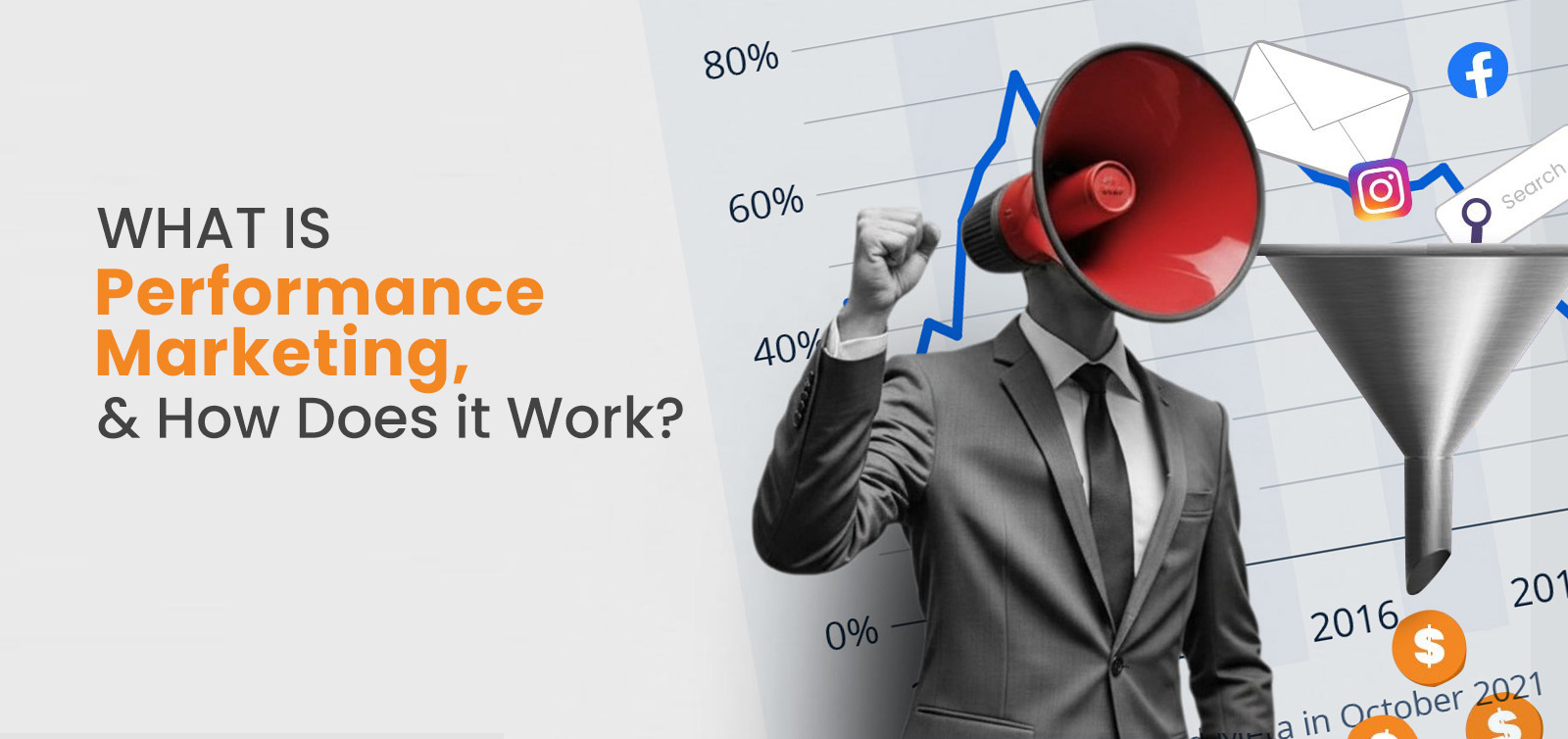
Performance marketing is a results-focused approach to marketing where businesses pay for specific actions rather than exposure alone. These actions can include clicks, leads, sign-ups, or sales, each measurable and trackable.
How It Differs From Brand Marketing
Brand marketing focuses on awareness and long-term perception. Performance marketing focuses on measurable actions that can be tracked and evaluated immediately.
Why “Performance-Based” Matters
The name comes from accountability. Every campaign is tied to performance metrics, making it clear what’s working and what isn’t. Instead of guessing impact, results are visible in numbers.
It’s marketing with receipts.
Performance Marketing vs Traditional Digital Marketing
Not all digital marketing is performance-driven, and that distinction matters.
Push vs Pull
Traditional campaigns push messages out and hope for attention. Performance marketing pulls users through intent, searches, clicks, and actions.
Cost vs Outcome
In many online marketing campaigns, budgets are fixed regardless of outcome. Performance marketing links spending directly to results, turning marketing into a controllable investment.
The Accountability Gap
Traditional paid marketing struggles with attribution. Performance marketing thrives on it. It doesn’t replace digital marketing, it operates within it, acting as the results-focused layer that brings clarity and control.
How Performance Marketing Works (End-to-End Flow)
A strong performance marketing guide always starts with understanding the flow.
Step 1: Traffic Acquisition
Users are reached through paid channels, search, social, display, or partnerships.
Step 2: User Action
Traffic alone doesn’t matter. What matters is action, clicks, form submissions, app installs, or purchases. This is the heart of conversion based marketing.
Step 3: Tracking & Attribution
Every action is tracked. Tools connect user behavior back to the campaign source, showing exactly where results came from.
Step 4: Optimization
Data reveals what works. Budgets are adjusted, creatives refined, and underperforming campaigns paused.
Tracking isn’t optional, it’s the backbone. Without it, performance marketing stops being performance-based.
Core Principle: ROI-Driven Marketing Explained
ROI driven marketing answers one question clearly: What did the business get back for what it spent?
What ROI Really Means
Return on investment (ROI) compares marketing spend to revenue generated. It shifts focus from activity to impact.
Why Performance Marketing Is ROI-First
A solid performance marketing strategy is built around this connection: money in → action taken → revenue out. Every decision is evaluated through this lens.
Why Businesses Prefer This Model
When results are measurable, decisions become confident. Budgets grow where ROI is strong and shrink where it isn’t. That’s why performance marketing is trusted, it replaces opinion with evidence.
Top Key Performance Marketing Channels (Where It Happens)
Performance marketing doesn’t live on one platform; it operates across multiple paid marketing environments, each with a specific role.
Paid Search (Google Ads)
Search captures intent. Users are already looking for solutions, making this one of the most conversion-focused performance channels.
Paid Social (Meta, LinkedIn, TikTok)
Social platforms drive discovery and demand. They work best when paired with strong targeting and conversion tracking within online marketing funnels.
Affiliate Marketing
Affiliates promote offers and earn based on results. This channel is performance marketing in its purest form, payment follows action.
Display & Retargeting
These channels reinforce interest. Retargeting keeps brands visible to users who already showed intent, improving conversion efficiency.
Influencer Performance Campaigns
When influencers are paid per sale or lead, influence becomes measurable. This merges credibility with performance accountability.
Each channel plays a different role, but all serve the same purpose: measurable growth through performance marketing.
Performance Marketing Metrics That Actually Matter
Metrics make or break conversion-based marketing, but not all numbers deserve attention.
- CPA: Cost per Acquisition
CPA shows how much is paid to generate one real result, like a lead or sale. Lower CPA usually means higher efficiency.
- ROAS: Return on Ad Spend
A core ROI-driven marketing metric. ROAS answers one question clearly: For every dollar spent, how much came back?
- CTR vs Conversion Rate
CTR measures curiosity. Conversion rate measures commitment. High clicks mean nothing if users don’t convert.
- LTV vs CAC
Lifetime Value shows long-term revenue. Customer Acquisition Cost shows upfront spend. Sustainable performance marketing keeps LTV higher than CAC.
Why Vanity Metrics Mislead
Impressions, likes, and reach look impressive but don’t pay the bills. Beginners often chase visibility instead of profitability, and that’s where budgets disappear.
Performance Marketing Strategy: How It’s Built (Big Picture)
A performance marketing strategy defines direction; tactics simply execute it.
Running ads is a tactic. Deciding who to target, what to offer, and how success is measured is strategy. Every strong performance marketing guide starts with understanding intent. The clearer the audience, the stronger the results. Strategy maps the user journey, from first interaction to final conversion, before any ad goes live. Budgets are distributed based on performance potential, not platform hype. Channels that convert earn more spend.
Why Strategy Enables Scale
Without strategy, growth stalls. With it, campaigns scale predictably because decisions are guided by data, not trial and error.
Step-by-Step: Building Your First Performance Marketing Campaign
This is where performance based marketing turns into action.
Step 1: Define the Conversion Goal
Decide what success means, lead form, purchase, or signup. Everything depends on this clarity.
Step 2: Choose the Right Channel
Match intent to platform. High-intent searches work well for sales. Discovery platforms suit awareness-led funnels within paid marketing.
Step 3: Build the Offer & Landing Page
The ad is the invitation; the landing page closes the deal. Clear value beats clever design.
Step 4: Set Tracking & Attribution
Install tracking tools before launch. If actions aren’t tracked, results can’t be measured.
Step 5: Launch With a Test Budget
Start small. Early data reveals what resonates without risking the full budget.
Step 6: Measure and Optimize
Pause weak ads, scale winners, refine messaging, and adjust targeting. Performance marketing grows through iteration, not perfection.
Execution isn’t about speed. It’s about learning fast and optimizing smarter.
The Role of Tracking, Data, and Attribution
A performance marketing guide without data is just theory.
Why Data Is Non-Negotiable
Performance marketing fails when results can’t be verified. Data turns marketing into a measurable system.
Pixels, Tags, and Analytics
These tools track user actions after clicks. They aren’t technical obstacles, they’re visibility tools.
Attribution Explained Simply
Attribution shows which touchpoint influenced a conversion. Not every sale happens after one click.
Why Last-Click Isn’t Enough
Focusing only on the final interaction ignores earlier influences. ROI driven marketing looks at the full journey, not just the finish line.
Performance Marketing Funnels (From Click to Conversion)
Funnels organize conversion based marketing into logical stages.
Awareness to Conversion
Users move from awareness to consideration to decision. Skipping stages weakens results.
Cold vs Warm Traffic
Cold users need education. Warm users need reassurance. Treating both the same lowers conversions.
Why Clicks Don’t Always Convert
A click shows interest, not intent. Funnels bridge that gap with relevance and timing.
Funnel Optimization Logic
Performance improves when each stage is refined separately, message, offer, and follow-up.
Performance Marketing vs Growth Marketing (Quick Clarity Section)
These terms often get mixed, but they aren’t identical.
| Section | Explanation |
| Key Differences | Performance marketing focuses on measurable actions. Digital marketing growth strategies focus on long-term experimentation. |
| Where They Overlap | Both rely on data, testing, and optimization. |
| When to Use Each | Performance marketing drives immediate, trackable results. Growth marketing supports broader expansion. |
| Why Beginners Confuse Them | Both use similar tools but different goals. Performance marketing asks, What worked? Growth marketing asks, What could work next? |
Common Performance Marketing Mistakes Beginners Make
Most beginners enter performance marketing with excitement, and lose budgets through avoidable mistakes. The first and most damaging error is running paid marketing campaigns without proper tracking. If conversions aren’t measured, performance can’t be improved.
Another common misstep is optimizing for clicks instead of outcomes. High click-through rates may look encouraging, but clicks don’t equal revenue. Conversions do. Beginners also tend to scale too early, increasing budgets before understanding what actually works. This often amplifies inefficiencies rather than results.
Ignoring landing page performance is another silent budget killer. Even the best ads fail if the page doesn’t convert. Traffic quality means nothing without conversion clarity. Finally, many expect instant ROI. Performance marketing is data-driven, not instant-gratification driven. Early phases are about learning, testing, and refinement.
Most failures don’t come from bad platforms, they come from rushing the process.
When Performance Marketing Works (And When It Doesn’t)
A strong performance marketing strategy works best when there’s clear demand, a defined audience, and a product that solves a real problem. E-commerce, SaaS, and service businesses with measurable conversions see the strongest returns.
However, ROI driven marketing struggles without product-market fit or sufficient budget for testing. Performance marketing isn’t magic, it can’t fix unclear offers, weak positioning, or unrealistic expectations. Results come from alignment, not hope.
Real-World Use Cases of Performance Marketing
Performance based marketing adapts across industries because it focuses on actions, not assumptions.
In e-commerce, it drives sales through intent-based ads and retargeting. SaaS brands use it to acquire trial users and subscriptions. Lead generation campaigns rely on form fills and calls. Service businesses convert local demand into bookings. Mobile apps track installs and in-app actions.
The common thread isn’t the industry, it’s clarity. When the action is clear, performance marketing thrives within online marketing ecosystems.
Top Performance Marketing Tools Beginners Should Know
Every performance marketing guide includes tools, but tools are support systems, not strategies.
Ad platforms like Google and Meta handle distribution. Analytics tools reveal user behavior. Tracking tools connect actions to spend. Testing tools refine messaging and offers.
The mistake beginners make is relying on tools without understanding goals. Digital marketing success comes from strategy first, tools second.
Future of Performance Marketing (What’s Changing)
The future of performance marketing is smarter, not louder. Privacy changes are reducing third-party data, pushing brands toward first-party insights. AI and automation are improving optimization, but human strategy still leads.
Success will come from better data interpretation, not blind scaling within online marketing platforms.
Final Thoughts: Performance Marketing Is a System, Not Ads
Performance marketing isn’t about running ads; it’s about building a measurable system. Results come from aligning goals, tracking data, understanding users, and improving continuously.
There are no hacks in ROI driven marketing, only clarity, patience, and iteration. Businesses that win treat performance marketing as a long-term engine, not a short-term fix.
When strategy, execution, and data work together, growth becomes predictable, not accidental.
You now have knowledge of performance marketing and its workings. The next step is implementation. Connect with Ignite Media to develop and execute performance marketing strategies that align with your business objectives.